The 5M Rubber Timing Belt: How a Tiny Pitch Drives the Big Precision Revolution in Modern Industry
- Share
- Issue Time
- Feb 4,2026
Summary
On a high-speed packaging line, an almost invisible 5mm pitch dictates the absolute precision of hundreds of transmissions per minute.
A maintenance supervisor at a food packaging plant once faced a persistent challenge: the timing belts on his production line required emergency replacement almost monthly, with each stoppage causing nearly 30,000 CNY in lost output.
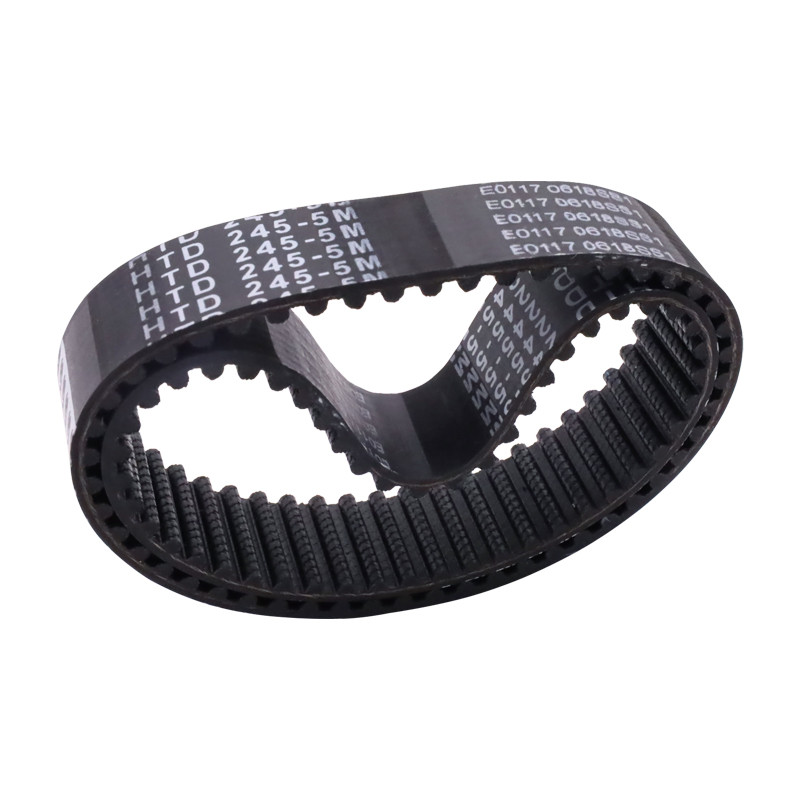
01 The Metric of Precision Transmission: Understanding the 5M Rubber Timing Belt
In the world of industrial power transmission, the designation "5M" represents a precise standard—a 5-millimeter pitch. This seemingly small dimension meets the exacting demands for transmission accuracy in modern automated equipment.
The 5M rubber timing belt is a precision member of the synchronous belt family, excelling in low-to-medium power transmission applications due to its unique design. It typically consists of three key layers: a high-strength fiberglass cord, a wear-resistant rubber tooth surface, and an anti-stretch backing material, each meticulously formulated and processed.
Compared to more common 8M or 14M belts, the primary advantages of the 5M belt are its higher tooth density and lower backlash. This means over the same transmission distance, the 5M belt provides more teeth in engagement, distributing the load, reducing wear per tooth, and enabling smoother power transfer. This makes it ideally suited for applications requiring short center distances and high precision.
The market primarily offers rubber and polyurethane types of 5M belts. Rubber belts are renowned for their excellent oil resistance, wear resistance, and anti-aging properties, typically operating between -30°C to 80°C. Polyurethane belts focus more on clean-room applications, offering superior dimensional stability.
02 Technological Breakthrough: How the 5M Rubber Belt Achieves Precision
Behind its simple appearance lies a perfect fusion of material science and precision engineering. Modern high-performance 5M rubber timing belts achieve unparalleled accuracy and reliability through innovations at three levels.
In material composite technology, leading manufacturers employ a compound formula blending Chloroprene Rubber (CR) with Polybutadiene Rubber (BR). This hybrid system retains CR's oil, heat, and aging resistance while incorporating BR's high elasticity and wear resistance. The tension member often uses specially surface-treated fiberglass cords, offering 2-3 times the tensile strength of common polyester cords with elongation controlled below 0.3%.
Structural design optimization is another major innovation. Adopting a curved tooth profile instead of the traditional trapezoidal shape creates a more uniform stress distribution at the tooth root, reducing stress concentration. Some premium products also feature lateral drainage patterns on the belt back to prevent slippage caused by liquid retention.
Manufacturing process innovation ensures product consistency and reliability. One-piece vulcanization molding creates a seamless integration of the belt body and teeth, eliminating weak points found in traditional spliced belts. Precision mold machining controls the tolerance of each tooth profile within ±0.02 mm, forming the physical foundation for high-precision transmission.
These innovations enable modern 5M rubber timing belts to achieve transmission efficiency exceeding 98%, operate 10-15 decibels quieter than traditional belts, and last 50% to 100% longer.
03 Application Scenarios: The Precision World Driven by 5M Belts
From food packaging to medical devices, textile machinery to electronics manufacturing, the 5M rubber timing belt plays an indispensable role in numerous fields requiring precise motion control due to its unique advantages.
In the packaging industry, the 5M belt is key to high-speed, accurate positioning. A typical automated packaging machine might use 8 to 12 5M belts of different lengths to drive film feeding, forming, filling, and sealing mechanisms. Each belt's length error must be controlled within 0.5 mm/meter to ensure strict synchronization of all processes.
Medical device manufacturing imposes extremely stringent requirements. 5M belts used in blood analyzers or auto-injectors need not only high dimensional stability but also compliance with medical-grade material standards, ensuring no harmful substance release during sterilization and consistent mechanical performance after long periods of inactivity.
Electronics manufacturing is another critical application. In SMT pick-and-place machines and chip testers, timing belts drive the high-speed, precise movement of nozzles, worktables, and probes. The challenge here is not just high precision (often ±0.05 mm), but also maintaining stable transmission under dynamic conditions involving frequent starts/stops and rapid acceleration/deceleration.
Applications in textile machinery demonstrate the 5M belt's adaptability to harsh environments. In the high-temperature, high-humidity atmosphere of dyeing workshops or the fiber-dust-filled air of spinning rooms, specially formulated 5M rubber belts resist various industrial media while maintaining accurate transmission ratios.
04 Selection & Maintenance: Maximizing the Value of Your 5M Belt
Selecting the right 5M belt and maintaining it properly are crucial for ensuring long-term, stable operation of the transmission system. Faced with a plethora of products, equipment manufacturers and maintenance engineers need a scientific evaluation framework.
Precise Selection is the first step. Beyond the basic number of teeth and belt width, consider the operating temperature, type of contacting media, and load characteristics. For example, white belts compliant with FDA standards are needed for food processing equipment, while oil-resistant formulas are required in environments with oil mist. Factors like dynamic load coefficients and start/stop frequency also directly impact belt life.
Professional Installation, often overlooked, is critical to performance. Correct procedure includes ensuring pulley shaft parallelism (deviation not exceeding 0.1 mm/100 mm), using specialized tensioning tools (avoiding improvised methods like levers), and performing an initial run-in period. Improper installation can cause premature failure, reducing service life by 30% to 50%.
Scientific Maintenance significantly extends the service cycle. Establish a regular inspection schedule focusing on tooth wear, cracks/delamination in the belt body, and whether tension is within the recommended range. Cleaning is equally important, as accumulated dust and grease accelerate wear. Some advanced companies now use infrared thermal cameras for periodic checks, identifying potential issues through temperature anomalies.
Improved Diagnostic Skills help reduce unplanned downtime. Learn to recognize failure modes: tooth wear typically starts at the root; longitudinal cracks often relate to overload; unusual noise may signal pulley misalignment or incorrect tension. Building a failure case library aids in rapid problem identification and effective action.
05 Future Trends: The Intelligent Evolution of the 5M Belt
With the rise of Industry 4.0 and smart manufacturing, the 5M rubber timing belt is undergoing a quiet yet profound transformation, evolving from a passive component into an intelligent sensing element, enabling new possibilities for condition monitoring and predictive maintenance.
Embedded Sensing Technology is a leading trend. Integrating micro-sensors within the belt allows real-time monitoring of tension changes, temperature distribution, and vibration signatures. Data transmitted wirelessly to a monitoring system provides direct input for predictive maintenance. One leading manufacturer has introduced a prototype capable of warning of potential failures 200-500 hours in advance.
Self-healing Materials research opens new paths for longevity. Inspired by biological self-repair mechanisms, scientists are developing rubber composites containing microcapsules of healing agents. When minor cracks form, the capsules rupture, releasing the agent to fill the damage. Though not yet fully commercialized, lab tests show potential lifespan increases of 40% to 60%.
Environmental Sustainability is becoming a key material development focus. Green characteristics like bio-based rubber, recyclable formulations, and low VOC emissions are shifting from optional to essential. Some European equipment manufacturers now explicitly require transmission part suppliers to provide full lifecycle environmental certificates, pushing the entire supply chain toward greater sustainability.
Digital Twin Technology is changing application methodologies. By creating high-fidelity virtual models, engineers can simulate performance under various conditions in a digital environment, optimizing selection and layout. This technology has helped reduce belt failure rates by 25% and cut on-site debugging time by 15%.